
The WECCUM Manifesto
Waste we prefer not to see
Modern circularity tells a compelling story.
Materials are recovered. Products are recycled. Resources remain in circulation. New technologies promise better sorting, separation, and recovery. Corporations publish ambitious circularity goals, while technology vendors and universities develop increasingly sophisticated methods for extracting value from waste streams.
All of this has value, but:
The waste streams that dominate circularity discussions are rarely the waste streams that dominate reality.
The materials most frequently discussed are somewhat clean, sorted, and — most importantly — economically attractive. Aluminum scrap, copper, batteries, e-waste, solar panels, and other high-value streams have become symbols of modern circularity. These materials, however, represent only part of the picture.
Packaging is produced with glued-on plastic windows and composite layers, often becoming contaminated with liquids, biogenic residues, or whatever nasty stuff lands in the same bag. Plastics, textiles, hygiene products, food waste, fines, and countless combinations of materials enter mixed streams that were never designed for later separation.
These materials rarely appear in circular economy success stories, yet they make up a substantial portion of the waste stream generated every day.
This Manifesto is about that stream.
The circularity gap
A simple observation sits at the center of WECCUM:
- Every recovery system creates a residual.
- Every sorting process generates rejects.
- Every recycling system leaves material behind.
The more closely one examines modern waste systems, the more difficult it becomes to avoid a fundamental question:
What happens to the material that remains after every economically recoverable fraction has been extracted?
Roughly half of municipal solid waste generated in the United States still ends up in landfills. Similar patterns can be observed across many parts of the world. The residual stream is not a niche phenomenon. It is one of the primary outputs of the current waste system.
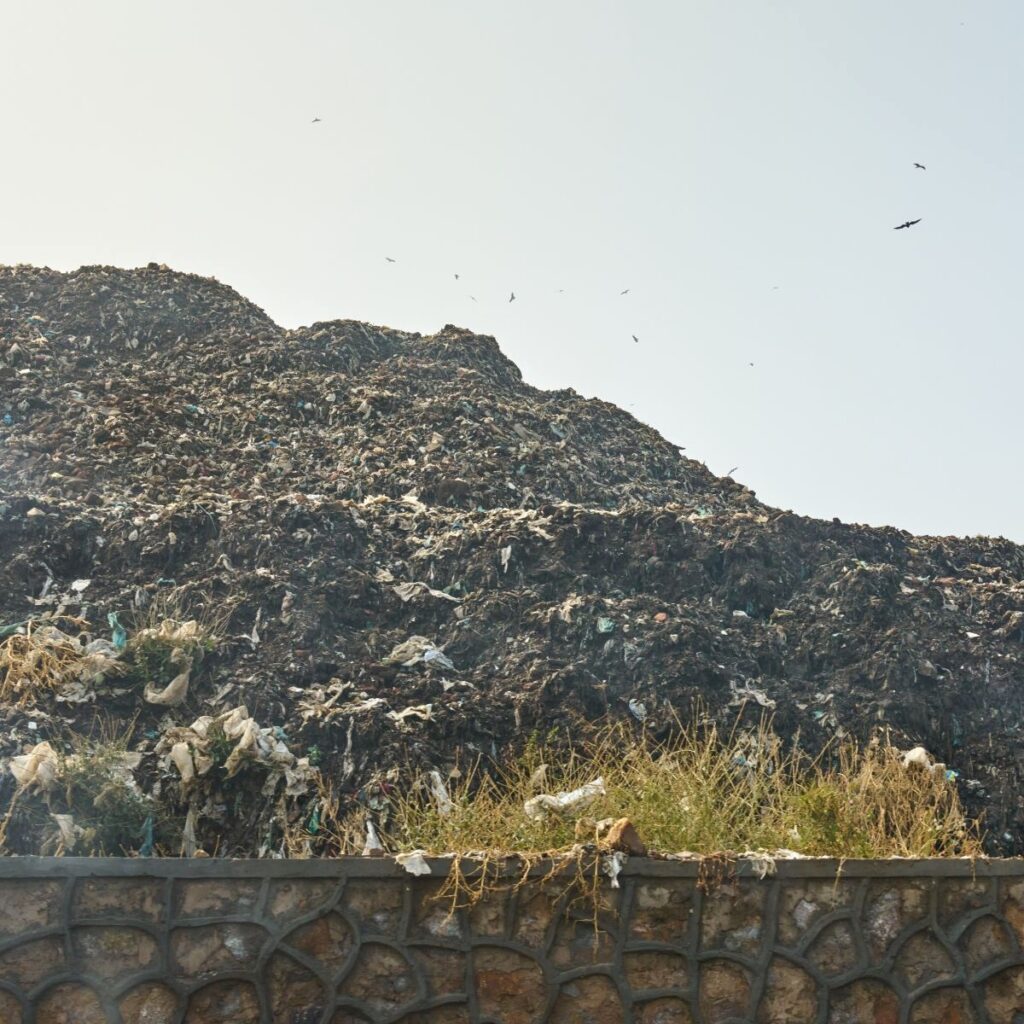
Technical possibility and practical recoverability (economics matters)
Modern circularity often focuses on what can be technically recycled.
Real waste systems are governed by what can be recovered economically.
Meaning, a material may be technically recyclable and still end up in a landfill. Collection costs, contamination, sorting requirements, transportation, market conditions, and processing economics all influence whether recovery actually occurs:
- Materials are recovered when recovery is economically viable.
- Materials are sorted when sorting is economically viable.
- Materials are recycled when recycling is economically viable.
When these conditions are absent, materials follow different pathways.
This observation should not be understood as a criticism. It is simply how infrastructure systems predominantly behave.
The implication, however, is profound.
Since the dominant waste stream is mixed, contaminated, and economically difficult to separate, the central challenge is not merely improving recovery technologies.
Instead, the challenge becomes the creation of infrastructure capable of handling the residual stream responsibly and at scale.
Why WECCUM exists
WECCUM emerged from a simple observation: The world does not suffer from a shortage of waste but from a shortage of scalable infrastructure capable of managing mixed waste while simultaneously recovering energy, materials, and climate value.
Rather than waiting for technological breakthroughs or the perfect circularity principle, WECCUM builds on three capabilities that already exist:
- Waste-to-Energy with proper exhaust gas treatment
- Carbon Capture
- Urban Mining
None of these technologies are new. Their systematic integration, however, remains surprisingly rare.
Thermal treatment transforms heterogeneous waste into concentrated mineral streams. Carbon capture reduces the climate impact of the process. Urban mining — including the recovery of materials from legacy waste deposits, landfills, bottom ash, slag, and other anthropogenic stocks — creates pathways to recover metals, minerals, and other valuable resources from those concentrated outputs.
Together, they form a practical architecture for managing the waste streams that continue to fall outside conventional circularity narratives.
WECCUM to fill the gap
At one extreme lies unmanaged or insufficiently managed waste: open dumping, landfills, environmental leakage, and inadequate infrastructure.
At the other lies high-value circularity: premium materials, closed-loop supply chains, robotic disassembly, precision recovery systems, and highly optimized and tracked material flows.
Both realities exist simultaneously, but most communities operate somewhere in between, relying on waste management systems that rather reflect both the lower and upper bounds of this spectrum.
WECCUM covers the middle ground and provides a realistic option for managing unwanted or overlooked residuals.
The WECCUM thesis
The future of circularity will not be determined solely by how effectively society recovers aluminum, copper, batteries, solar panels, or other valuable resources.
It will also be determined by how responsibly it manages the mixed, contaminated, and economically difficult fractions that persist after recovery has already done its work.
WECCUM exists because those inherently unwanted fractions exist — and because somebody still has to deal with them properly.